Showing posts with label brewing. Show all posts

Saturday, February 22, 2014

A Brief Summary of Hop Chemistry

It seems that the whole craft beer community is obsessed with hops. Consumers go batshit crazy over beers hopped and dry-hopped with the latest and greatest proprietary poster children of breeding programs. (Three Floyds Zombie Dust blew the doors of for Citra, and as of late Mosaic is the darling of the brewing world.) Hop Contracts are the de facto norm for any and all "in-demand" hops and for most anything that's commonly used in the states. Good luck getting your hands on Amarillo, Citra, Mosaic or Simcoe in quantities of a pound or more.
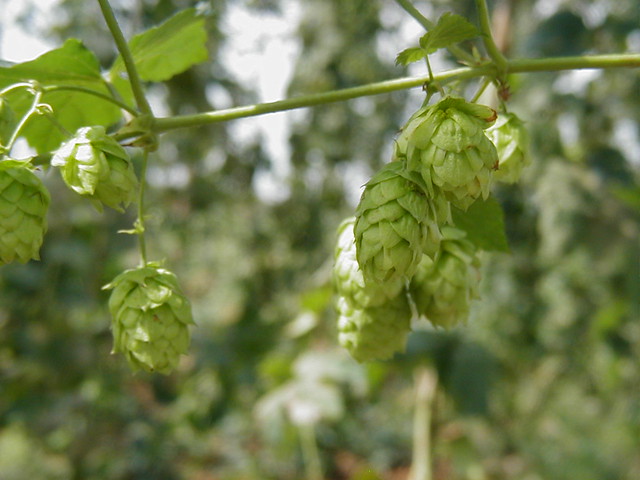

Most everyone reading this blog knows that hops impart bitterness, aroma and flavor into beer. But the commonly accepted knowledge amongst homebrewers about how this actually works can be summed up in a couple of sentences: Adding hops with high alpha acid content at the beginning of the boil contributes to bitterness. Adding hops toward the end of the boil and through dry hopping enhances aroma and flavor. 

Thankfully, the greater brewing community (largely commercial brewers and academics the like of Dr. Charlie Bamforth, with a substantial contribution from Stan Heironymus and the Brewers Association) is starting to peel the layers back on the actual chemistry at work here and share that knowledge.

Let's talk about bitterness first: Alpha acids are indeed the compounds which contribute to bitterness in finished beer, but they don't do it directly. During the boil (in the presence of heat and kinetic energies) they change their structure slightly through a process called isomerization, which simply means that the atoms in the molecule re-arrange themselves and exhibit different chemical properties.

Adhumulone, cohumulone, and humulone are the three distinct compounds which comprise the majority of the alpha acid content in a hop.

Adhumulone generally represents a minority of the alpha acid content and its contribution to bitterness is not deeply understood.

Cohumulone and humulone make up the majority of alpha content. Noble hops tend to have a higher ratio of humulone to cohumulone and as such cohumulone was considered less desirable and to impart a "harsher" bitterness. As such, it's common to see a humulone / cohumulone ratio or percentage cohumulone content published in hop data. However, newer high-alpha hops have been developed which have higher cohumulone content without any "harshness".

Interestingly, the isomerized alpha acids contribute to both foam stability and provide anti-bacterial properties on top of contributing bitterness to the finished beer.

On to aroma and flavor: Hops also contain a small percentage (by weight) of essential oils which are almost entirely responsible for their flavor and aroma contributions. There are numerous oil fractions present in hops, but four in particular make up the majority : caryophyllene, farnesene, humulene and myrcene. Each of the oil fractions has different aroma and flavor profiles and volatilize at different temperatures, although they'll all volatilize off during an extended boil. As such, late kettle, flame-out / whirlpool and dry-hopping all emphasize the aroma and flavor contribution by allowing these essential oils to stick around. 

Caryophyllene adds a spicy, herbal and/ or woody character similar to humulene when boiled. Its effect on flavor when fresh is not well understood. Interestingly, it is one of the chemical compounds identified as contributing to the spicy character of black pepper and is also found in substantial quantities in Basil, Canabis, Cloves, and Oregano. Caryophyllene oxidizes quickly and as such its aroma / flavor contributions will drop off quickly in finished beer.

Farnese is is typically only found in significant quantities in noble hops. Its fragrance has green, woody, vegetative notes with hints of lavender. Flavor-wise, it adds the essence of herbs and organic wood-like offsets. Oxidation degrades its essence rapidly, and storing in air tight refrigerated packaging increases its storability.

Humulene  is thought to lend the distinctive "noble" character to noble hops; most varieties traditionally considered noble are high in humulene, while many bittering hop varieties have very low levels. It contributes woody, earthy, and herbal aromas and flavors. The noble character is strongest when the hops are used in dry hopping or late hop additions; if boiled for longer periods, humulene lends the finished beer an herbal or spicy character. Oxidation degrades its essence rapidly, and storing in air tight refrigerated packaging increases its storability. Humulene does have a higher boiling point relative to the other oil fractions and will contribute more aroma and flavor if used earlier in the boil.

Myrcene contributes a green, herbaceous, citrusy, resinous aroma often associated with "American" or "fresh" hop character. It is highly volatile and loses much of its aroma when boiled. It is also found in Cannabis, Lemongrass, Mangoes, Thyme, and Verbena. Myrcene is highly volatile / unstable and as such will provide maximum flavor contribution when used as a late / dry hop and in beer consumed when fresh.

There's a lot of chemistry at work here. (Frankly, far more than I grok at this point.) But it's safe to say that there's a lot more to adding bitterness and flavor to our beer than just grabbing a couple packages of pellets at the homebrew shop and adding them at the beginning and end of the boil. 

If I had to guess, one could dive in to the oil profiles of individual hops and start to determine what flavors and aromas they'd contribute when used at different points in the process. (More to come soon on that...)

Saturday, August 17, 2013

Nerding Out

There's a lot of beer-related information floating around on the internet. You've got the forums, reddit, blogs ranging in quality from ones like mine up to those of professional brewers which all abound with information that tends to be highly opinionated and often representative of the conventional homebrew wisdom. But it's rare to find genuinely scholarly resources.

Thankfully, courtesy of BeerNews I stumbled upon the online archives of the Journal of the Institute of Brewing, which is a publication of the Institute of Brewing and Distilling. There are 119 years (yes, YEARS) of journals at 4 volumes per year. The articles run the gamut from very technical microbiology to theoretical methods for calculating the properties of finished fermentations to higher level summaries of years and years of research.

It's pretty amazing and generous that someone decided to put this massive cache of knowledge out there for the brewing community. Much of the information is well beyond the scope of what a homebrewer (or frankly anyone without a microbiology degree) can really grok, but there are some extremely informative and practical articles in each volume.

Just some quick tidbits from some of the reading I've done:

- Concrete studies on the viability of different hop strains stored in different temperature, light and oxygen conditions. (Some of the conventional wisdom is that temperature is more important than exposure to oxygen. Their study states quite the opposite. Furthermore, different cultivars showed different decays of alpha and beta acids. )
- A summary of the attributes of finished beer which can inhibit or promote the growth of bacteria (good and bad) and specifics about the conditions under which certain bacteria can thrive. Fresh, unisomerized hops inhibit most strains of lactic acid bacteria, but not all. (I knew that aged hops were traditionally used in lambics, but never really made the connection as to exactly why.)
-

Monday, September 3, 2012

Water Basics

I had the opportunity to talk about the basics of water as it relates to brewing with the soon to be founder of Panic Brewing at the last Square Kegs meeting. Rather than re-writing the whole talk, I've posted the notes here. Gary took the liberty of adding some of the more technical details based on his education at the American Brewers Guild.

You can check it out here.

Monday, August 20, 2012

10,000 Hours?

Hey J - you look pretty bored. Oh and Diesel is characteristically
not giving a shit about anything. Except maybe that squirrel.
In his book Outliers, Malcolm Gladwell talks about the 10,000 hour rule. His poses the theory that to really reach mastery of any skill or craft you need to spend at least 10,000 hours honing it. He talks about the Beatles spending 10,000 hours over a few years playing in Hamburg Germany and about Bill Gates growing up spending his weeknights and summers in a computer lab starting at a young age.

I'm positive I haven't spent ten thousand hours brewing. Since I started tracking with BeerAlchemy in December of 2010, I have brewed 32 batches (195.75 gallons) either solo or with Jeremy. I started brewing in early 2004 and conservatively did about another 30-40 extract batches in that period of time. That probably works out to a bit under 1000 hours of brewing and cellar maintenance during fermentation. I've listened to most of the programming the brewing network has put out there, read a rather ridiculous volume of books and blogs, and certainly spent many many hours seeking out and trying new beers.

All in all, I really don't know how much time I've spent in the hobby and related activities. But what I do know (and the picture in this post sums it up well) is that it dawned on me this Sunday that there were certain points of the brewing process during which Jeremy and I didn't even need to talk this weekend. We just flowed from one task to the next, having dialed in our process on our equipment. I was laughing about our first all grain effort in which we screwed up royally on the mash temp, didn't quite hit our numbers, spent the whole time freaking out about whether we were screwing it all up and just barely made it through the whole process in 7 or 8 hours. Contrast that with a day which looked a lot like that picture. Mostly we just stay a couple of steps ahead and then sit around and way until it's time for the next burst of activity.

I don't purport to be an expert. We're just barely scratching the surface of making predictably good all grain beer and understanding how the inputs actually affect the finished product. But I think Malcolm's on to something. Maybe in another few years when I actually hit that 10,000 hour mark I'll start taking home some competition medals or even a best in show. Although at this point, I'm not really that worried. I'm having way too much fun along the way.

Friday, August 17, 2012

Rebrew: Citra IPA

As Jeremy and I have really started to dial in our all-grain process, we've gone back to a couple of beers we brewed last summer and brewed them again. I'm still on enough of a learning curve that we've been able to noticeably improve on those earlier attempts.

In particular, we re-brewed a Russian Imperial Stout early this spring which we'd done in the fall. The original beer was pretty solid, but lacked the velvety, chocolatey notes which really needed to shine for it to be great. We treated the water with a mix of Calcium Choloride (CaCl2) and Gypsum (CaSO4) this time around instead of a single CaSO4 adjustment in the fall. We also pitched onto yeast cakes from ten gallons of Ordinary Bitter brewed the week prior. Between those two small tweaks, we ended up with a far better end product. The aforementioned chocolate and coffee notes were there. Using a substantially larger pitch of yeast got us to a better finishing gravity, and using a slightly different carbonation level produced just the right level of carbonation.

So up next, we're re-brewing our Citra IPA from last summer. It was already a damn good beer, so we wanted to brew it again this year. However, given the opportunity to tweak a few things I wanted to tune up the malt profile a bit and accentuate the unique character Citra brings to the party. Based on the recent process improvements we've made to improve on our hop character, I'm pretty confident we'll get there by using a low temperature whirlpool addition. With the malt character, we're going to use an English Ale yeast (Wyeast 1335) which should accentuate the bread / biscuit character a bit more than a clean american ale yeast. We'll probably also tweak the water adjustments a bit and go with a mix of calcium chloride and gypsum instead of strictly gypsum.

The yeast starter is going and brewday is Sunday. I'll have some results in a couple of weeks!


Thursday, December 22, 2011

Things I Wish I'd Known

I've been listening to some back episodes of Brew Strong during my commutes this past week and particularly those about brewing water. There's a ton of useful information in them about how water chemistry makes a difference and some pretty advanced information about how to adjust your brewing water for different styles based on the grain bill you're using and your local water. I'll save that for a future post.

However, there are some really simple take-aways which I wish someone had told me early on:

  • There's a historical reason that certain cities brewed different styles of beer. More alkaline water supplies need to be balanced with roasted, darker malts. They contribute a lower pH to the mash and brewing process overall, which gets the mash pH and final beer pH into the optimal range. Likewise, cities with more neutral water supplies brewed lighter colored beers because they didn't need the acidic contribution of the roasted malts.
  • If you're an extract brewer, use distilled water. The malt extract you're using already has an appropriate mineral content, acidity and hardness for the malts used to make it. Don't bother with anything else.

(Image used under the creative commons license. The original is here.)