Saturday, February 22, 2014

A Brief Summary of Hop Chemistry

It seems that the whole craft beer community is obsessed with hops. Consumers go batshit crazy over beers hopped and dry-hopped with the latest and greatest proprietary poster children of breeding programs. (Three Floyds Zombie Dust blew the doors of for Citra, and as of late Mosaic is the darling of the brewing world.) Hop Contracts are the de facto norm for any and all "in-demand" hops and for most anything that's commonly used in the states. Good luck getting your hands on Amarillo, Citra, Mosaic or Simcoe in quantities of a pound or more.
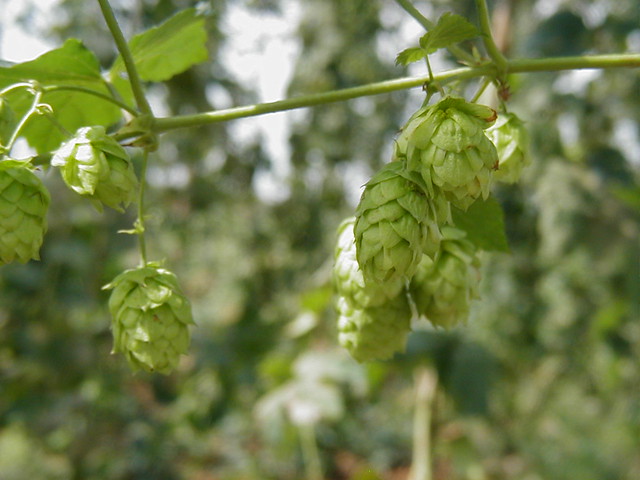

Most everyone reading this blog knows that hops impart bitterness, aroma and flavor into beer. But the commonly accepted knowledge amongst homebrewers about how this actually works can be summed up in a couple of sentences: Adding hops with high alpha acid content at the beginning of the boil contributes to bitterness. Adding hops toward the end of the boil and through dry hopping enhances aroma and flavor. 

Thankfully, the greater brewing community (largely commercial brewers and academics the like of Dr. Charlie Bamforth, with a substantial contribution from Stan Heironymus and the Brewers Association) is starting to peel the layers back on the actual chemistry at work here and share that knowledge.

Let's talk about bitterness first: Alpha acids are indeed the compounds which contribute to bitterness in finished beer, but they don't do it directly. During the boil (in the presence of heat and kinetic energies) they change their structure slightly through a process called isomerization, which simply means that the atoms in the molecule re-arrange themselves and exhibit different chemical properties.

Adhumulone, cohumulone, and humulone are the three distinct compounds which comprise the majority of the alpha acid content in a hop.

Adhumulone generally represents a minority of the alpha acid content and its contribution to bitterness is not deeply understood.

Cohumulone and humulone make up the majority of alpha content. Noble hops tend to have a higher ratio of humulone to cohumulone and as such cohumulone was considered less desirable and to impart a "harsher" bitterness. As such, it's common to see a humulone / cohumulone ratio or percentage cohumulone content published in hop data. However, newer high-alpha hops have been developed which have higher cohumulone content without any "harshness".

Interestingly, the isomerized alpha acids contribute to both foam stability and provide anti-bacterial properties on top of contributing bitterness to the finished beer.

On to aroma and flavor: Hops also contain a small percentage (by weight) of essential oils which are almost entirely responsible for their flavor and aroma contributions. There are numerous oil fractions present in hops, but four in particular make up the majority : caryophyllene, farnesene, humulene and myrcene. Each of the oil fractions has different aroma and flavor profiles and volatilize at different temperatures, although they'll all volatilize off during an extended boil. As such, late kettle, flame-out / whirlpool and dry-hopping all emphasize the aroma and flavor contribution by allowing these essential oils to stick around. 

Caryophyllene adds a spicy, herbal and/ or woody character similar to humulene when boiled. Its effect on flavor when fresh is not well understood. Interestingly, it is one of the chemical compounds identified as contributing to the spicy character of black pepper and is also found in substantial quantities in Basil, Canabis, Cloves, and Oregano. Caryophyllene oxidizes quickly and as such its aroma / flavor contributions will drop off quickly in finished beer.

Farnese is is typically only found in significant quantities in noble hops. Its fragrance has green, woody, vegetative notes with hints of lavender. Flavor-wise, it adds the essence of herbs and organic wood-like offsets. Oxidation degrades its essence rapidly, and storing in air tight refrigerated packaging increases its storability.

Humulene  is thought to lend the distinctive "noble" character to noble hops; most varieties traditionally considered noble are high in humulene, while many bittering hop varieties have very low levels. It contributes woody, earthy, and herbal aromas and flavors. The noble character is strongest when the hops are used in dry hopping or late hop additions; if boiled for longer periods, humulene lends the finished beer an herbal or spicy character. Oxidation degrades its essence rapidly, and storing in air tight refrigerated packaging increases its storability. Humulene does have a higher boiling point relative to the other oil fractions and will contribute more aroma and flavor if used earlier in the boil.

Myrcene contributes a green, herbaceous, citrusy, resinous aroma often associated with "American" or "fresh" hop character. It is highly volatile and loses much of its aroma when boiled. It is also found in Cannabis, Lemongrass, Mangoes, Thyme, and Verbena. Myrcene is highly volatile / unstable and as such will provide maximum flavor contribution when used as a late / dry hop and in beer consumed when fresh.

There's a lot of chemistry at work here. (Frankly, far more than I grok at this point.) But it's safe to say that there's a lot more to adding bitterness and flavor to our beer than just grabbing a couple packages of pellets at the homebrew shop and adding them at the beginning and end of the boil. 

If I had to guess, one could dive in to the oil profiles of individual hops and start to determine what flavors and aromas they'd contribute when used at different points in the process. (More to come soon on that...)

Tuesday, November 5, 2013

Fresh Trumps Damn Near Everything

A couple of guys from the club and I have been studying for the Beer Judging Certification Progarm (BJCP) exam since last January. In the course of doing so, we've tasted a lot of beers. They've been all over the map in terms of style, age and quality. Most of what we've tried has been out of my wheelhouse in terms of what I'd typically drink and some of what we've sampled has legitimately blown my mind.

The examples of Eisbock and Weizenbock we tried were nothing like what I anticipated. Eisbock is a somewhat eccentric style in which a doppelbock (think a malty, rich, but very drinkable beer) is freeze concentrated up to anywhere between 7 and 30% abv. I expected it to be hot, sharp and far more alcohol focused than the example we tried. It wasn't. It was just richer, maltier, and perfectly balanced. The brewer somehow managed to keep the beer in balance and the net result was just a bigger, more flavorful version of the base style.

On the other hand, we've tried a fair amount of shitty, stale beer. It's tough to get many of the classic examples (at least in the BJCP guidelines) here in the states. A long, bouncy trip across the ocean in a container without any sort of temperature control (presumably), followed by an indeterminate amount of time on a warm shelf in a liquor store just doesn't bode well for freshness.

What starts out as an amazing example of an English Bitter (a low-gravity, balanced session beer) or a fantastic German Pilsner (clean, grainy and assertively hoppy) can both fade into boring, lifeless, cheesy, almost grapey beer. And that's a damn shame. Not only because they're merely a shadow of what they were leaving the brewery, but because they also make it difficult to appreciate just how amazing those beers can be.

Contrast that with taking a trip to your local brewery and trying that same German Pils (Half Acre Pony Pils) or that Bitter (Adam's Best at Revolution this past weekend). They might not be dead nuts on for the style, but they're going to be damn good. You'll get that huge noble hop character and be able to taste the subtle malt complexity before it fades away under the impact of heat and time. Do yourself a favor and try a style you wrote off a long time ago because of a bad "import" example. A great, fresh pilsner can have hop character that might blow your mind.

 (Yes, yes. I know that there are beers that age well and travel better than the examples I cited. But that's not the point. It's about giving the styles that get a bad rap because they don't travel well a chance.)

Saturday, August 17, 2013

Nerding Out

There's a lot of beer-related information floating around on the internet. You've got the forums, reddit, blogs ranging in quality from ones like mine up to those of professional brewers which all abound with information that tends to be highly opinionated and often representative of the conventional homebrew wisdom. But it's rare to find genuinely scholarly resources.

Thankfully, courtesy of BeerNews I stumbled upon the online archives of the Journal of the Institute of Brewing, which is a publication of the Institute of Brewing and Distilling. There are 119 years (yes, YEARS) of journals at 4 volumes per year. The articles run the gamut from very technical microbiology to theoretical methods for calculating the properties of finished fermentations to higher level summaries of years and years of research.

It's pretty amazing and generous that someone decided to put this massive cache of knowledge out there for the brewing community. Much of the information is well beyond the scope of what a homebrewer (or frankly anyone without a microbiology degree) can really grok, but there are some extremely informative and practical articles in each volume.

Just some quick tidbits from some of the reading I've done:

- Concrete studies on the viability of different hop strains stored in different temperature, light and oxygen conditions. (Some of the conventional wisdom is that temperature is more important than exposure to oxygen. Their study states quite the opposite. Furthermore, different cultivars showed different decays of alpha and beta acids. )
- A summary of the attributes of finished beer which can inhibit or promote the growth of bacteria (good and bad) and specifics about the conditions under which certain bacteria can thrive. Fresh, unisomerized hops inhibit most strains of lactic acid bacteria, but not all. (I knew that aged hops were traditionally used in lambics, but never really made the connection as to exactly why.)
-

Wednesday, August 7, 2013

You Don't Want Every Last Ounce of Beer You Produce

No. Really. You don't.

When I first started brewing, I didn't want to lose a single drop of my precious homebrewed nectar. I paid dearly for that extract and those hops, worked really hard to produce that three gallons of stovetop wort and gingerly poured it all through a fine china cap into a bucket of icewater to cool and dilute it back to 5 gallons of finished wort. 

After fermentation, I'd every so carefully siphon each and every drop of finished beer off of the trub and into the bottling bucket and then make sure I didn't leave even an ounce of beer in my bottling bucket. 

I loved each and every drop of those early batches. You should love yours too.

That said, I've learned that it's ok to leave some of that sweet nectar behind at each stage of the process. Even though I won't get to drink it in the long run, the finished product is better when you anticipate a some waste along the way. If you whirlpool (even with a big spoon), that last half gallon or gallon of wort you leave behind in the kettle happens is thick with hop solids and proteins from your hot break. Leaving it behind will yield a much clearer, brighter finished beer. 

Let your fermentation run its course, and then do whatever you can to drop the temperature for a few days to encourage the solids in suspension to settle out. Then siphon carefully, but leave a half inch or an inch of beer in the fermentor on top of your yeast cake. It's not worth it to risk transferring that crap into your packaged end-product. Dead yeast and spent hops? Not so tasty. Your finished batch will be clearer and more stable. This is good.

At the end of the day, base malt (and even extract) are cheap. 

Using prices for fermentables that are representative of what we see here in Chicago, here are some hard numbers to hopefully demonstrate that it's not a very expensive proposition to make enough wort to leave some behind:

Liquid malt extract (LME) is about $3 / lb. To make 5 gallons of 1.051 SG wort (a 5% beer), you'd use 6.8 lbs. To make 6 gallons of wort and yield 5, you'd use 8 lbs. So as an extract brewer it'd cost you an extra $3.60 to get better tasting, clearer beer. Not bad considering that an extract batch runs anywhere from $30 - $50 for 5 gallons.

If you're an all grain brewer, it's even cheaper. If you buy it buy the pound, base malt runs about $1.25 / lb. To make 5 gallons of 1.052 SG wort, you'd used 9.3 lbs. To make 6 gallons, you'd use 11 lbs. So it'll cost you a whopping $2.13 extra.

It's worth it. Trust me. Between this and the extra buck or two it costs to make a yeast starter, you'll improve the quality of your beer massively over not doing either.

*My assumption is that bittering hops are negligibly cheap and barely affect these costs.

*If you are buying base malt by the pound and brew with any regularity, do yourself a favor and find a local homebrew shop where you can buy it in sack quantity. My cost on 2-Row is about $0.70 / lb. 

Thursday, June 6, 2013

Homebrew Hack : Monitoring Your Fermentation Gravity

At the last Square Kegs meeting, I was talking to some of the other club members about the hack we use to monitor fermentation progress without constantly pulling gravity samples out (or off of) our fermentors. Since it didn't seem like the majority of the club did this or had heard of it, it seems post-worthy.

I can take no credit for this idea. For the sake of argument, I'll just assume that Jeremy stumbled upon this on his own. (I'm sure that someone else out there did this first, but I like giving him the credit.)

Typically I'll take gravity readings throughout our brew day in order to make sure we're on target for our numbers and to determine if we need to adjust up or down towards the end of the boil. Typically I'll pull an O.G. (original gravity) reading during cooling. Then, once fermentation visibly starts, I'll use a wine thief to fill a sanitized sample jar and drop a hydrometer in it. We'll then leave the sample jar full of fermenting wort in our fermentation freezer and use it for gravity readings. Depending on the beer, it can be a little tough to read the hydrometer through the yeast and other trub that accumulates in the sample jar, but it's easy enough to get an approximate reading.

I also realize that technically the volume of wort in a fermentor is going to be a couple of degrees warmer in the middle of the fermentor and that there will be a difference in pressure between the two. However, I think that the reduced risk of infection and the ability to adjust fermentation temperature or dry hop at the appropriate time totally outweighs whatever differences those factors introduce.


Friday, March 15, 2013

My First Foray Into Judging

My homebrew club, Square Kegs, hosted our second annual Winterbrew competition back in the end of January. Jeremy and I had the awesome opportunity to work with the member of our club organizing the competition on a lot of the behind the scenes logistics and to actually judge a couple of flights as we're both taking a BJCP study course currently.


My experience with competitions up to this point had been simple: go online, fill out a form, send / drop off some beer, get a scoresheet back, read said scoresheet and go "hmm, ok. I guess that guy [loved my beer and has the best palate ever! || hated my beer because he doesn't know shit!] (Optionally pat myself on the back for a good score or good feedback.)

This year was really different. There is a ton of work that goes on behind the scenes and ahead of time to prepare. Beer needs to be cellared and cataloged for easy retrieval by the stewards. The flights need to be well organized by category for the judges. Little things like the type of plastic cup, mechanical pencils instead of wood and lighting all matter. From the outside it seems like it'd be a rocking good time : hundreds of beers to try and the judges just "have" to power their way through them in a few hours. Cue mental image of a bunch of beer geeks having a party. Not so. It's a serious, well-organized, highly focused endeavor.

Now The biggest insights I gained were into the actual process of judging. I had a preconceived notion which was largely blown away by reality. Firstly, it's highly subjective and hence really difficult. As a judge, you have about 15 minutes to taste each beer. You taste about 8-10 beers per flight. The beers vary in style, either just a bit for a large, popular category like IPA or immensely for wide-open categories like specialty or vegetable, herb and spice.

I think it's different for really experienced judges who have really calibrated their palates, but as a novice I was evaluating a beer against a written description of what it should be. No matter how elegantly written the BJCP styles are, it's still tough to translate written words into a sensory experience.

This might also change with experience, but I was pretty surprised by the varying sensitivity to different flavors, aromas and off-flavors. I am pretty sensitive to acetaldehyde, but apparently I can't detect diacetyl if it's smacking me in nose.

Finally, I was very surprised at how collaborative the judging process actually is. Often times if there's a wide spread in scores, the judges will discuss the beer and come to an agreement. The goal is to get scores within a somewhat narrow range, but one judge usually adjusts theirs up or down to get there. So the initial feedback about a beer might not really match up to the score it ended up with.

I came away with a whole new respect for the process and a few considerations for entering competitions:

  • If I enter a Belgian, it will not have overwhelming hot alcohol or phenolic (band-aid, hot-dog, nasty) notes. Belgian Styles ≠ I'll just let this ferment however hot it wants too and call it a Belgian!
  • If I enter a spice beer, I'll use a tincture or some other controlled means of adding the space after the beer is done fermenting. Or I'll split the batch and blend it back. Far too many of the beers I tasted had massive, overwhelming spice character.
  • I'll be really careful about categorization and specifying the base category on anything specialty. It's really hard to judge a beer if you have absolutely no idea what it is...


Wednesday, March 13, 2013

First Medal!

Jeremy and have entered beers in two competitions so far this year. (We also helped to run one that our club, Square Kegs, put on. That's another post.)

That's a medal all right. More nerdy photos on instagram
We entered a handful of beers in both and won our first official medal! It's definitely a proud moment, particularly given the size of the Drunk Monk Challenge competition this year (806 entries) and the size of the Porter Category (29). We brewed the Robust Porter recipe out of Brewing Classic Styles and took third place with a score of 34.

Interestingly, we also entered the same beer in our Winterbrew competition and scored a 32.5 a month ago. The judges notes were all generally aligned, but I was particularly impressed by the feedback from a master judge who picked out the one major process flaw in the beer. We brewed on December 1st here in Chicago and ended up mashing at 151F instead of our target of 154F. (It gets cold here. We use coolers and a single infusion. For now.)

Empirically, we're getting better as brewers. The beers we entered in competition last year averaged high twenties with one outlier in the high thirties. This year, we're averaging mid-thirties.

Here's a recap of our entries and scores:

Winterbrew 2013:

Munich Helles: 34
Robust Porter: 32.5
Rye Pale Ale: 32
Russian Imperial Stout: 32.3

Drunk Monk: 

Robust Porter: 34
Russian Imperial Stout: 24
* I'm fairly certain that we mis-categorized the stout by not entering it as a wood-aged beer. It was in a 5 gallon whiskey barrel for a month and interestingly enough, won a club competition which coincided with Goose Island's Quest for the Imperial Goose.